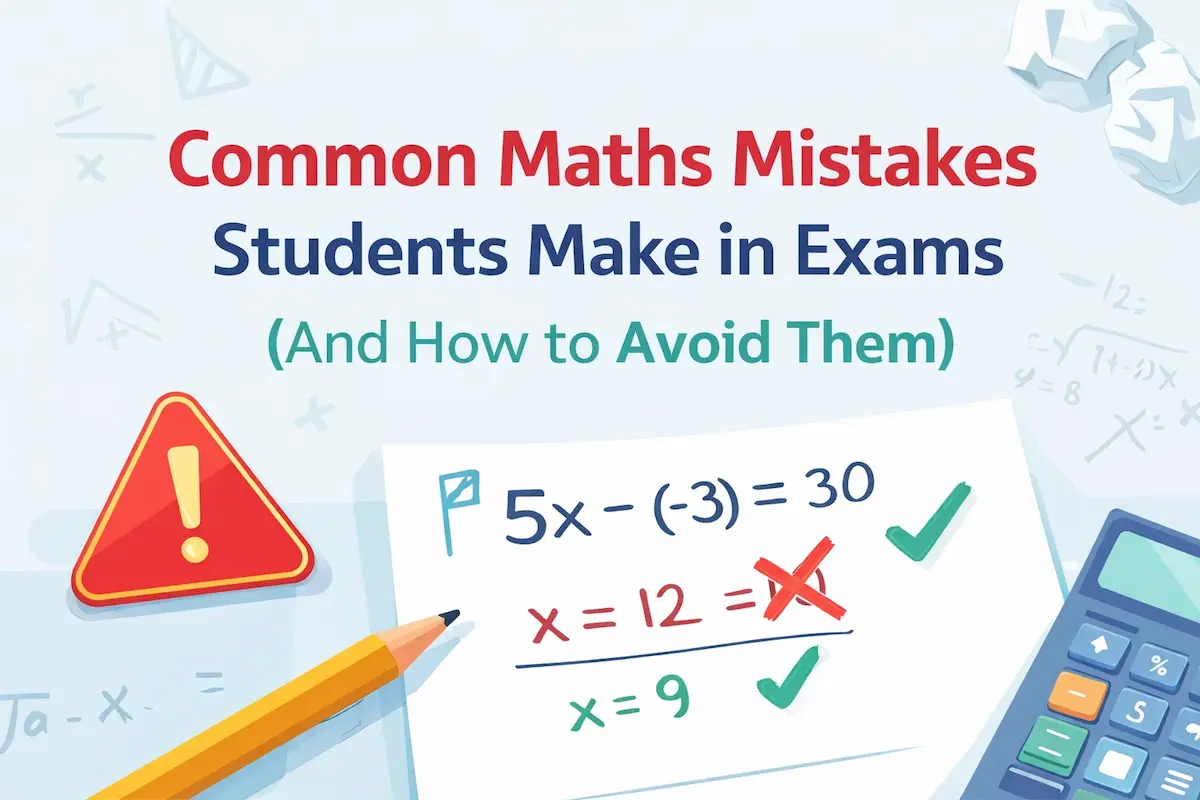
Common Maths Mistakes Students Make in Exams (And How to Avoid Them)
Many students know the maths syllabus well but still lose marks in exams due to avoidable mistakes. These errors are not always about weak concepts—often they are caused by exam pressure, poor presentation, or small calculation slips.
In this blog, we’ll break down the most common maths mistakes students make in exams and show simple, practical ways to avoid them, so your preparation actually converts into marks.
Calculation Errors Under Exam Pressure
Even strong students make calculation mistakes when rushing through questions. Missing a negative sign, copying a number incorrectly, or skipping a step can cost easy marks.
How to avoid it:
Write every step clearly (even for “easy” questions)
Double-check signs (+ / −) before final answers
Leave space between steps to avoid confusion
Misunderstanding the Question
A very common mistake is solving the question correctly—but answering the wrong thing.
Examples:
Finding perimeter instead of area
Solving for x but not writing the final value asked
Ignoring “round off” or “approximate” instructions
How to avoid it:
Underline keywords like find, prove, evaluate, approximate
Re-read the question after solving
Match your final answer with what is asked
Skipping Steps to Save Time
Many students skip steps assuming the examiner will “understand”. Unfortunately, marks are awarded step-wise, not by assumption.
Why this hurts marks:
No partial marks if the final answer is wrong
Examiner cannot guess your thinking
Mistakes become harder to trace
Correct approach:
Show formulas clearly
Write intermediate values
Box or underline final answers
Poor Presentation and Untidy Work
Even correct answers can lose marks if the work is messy or confusing.
Common presentation issues:
Overwritten steps
No spacing between answers
Diagrams without labels
How to improve presentation:
Use separate lines for each step
Label diagrams properly
Keep margins clean for rough work
Poor Time Management During Maths Exams
Many students spend too much time on difficult questions and rush through easy ones.
Smart exam strategy:
Scan the paper in first 2 minutes
Attempt easy questions first
Mark tough questions and return later
Not Reviewing Answers at the End
Skipping revision is one of the biggest regrets students have after exams.
What to check in last 10 minutes:
Signs (+ / −)
Units
Final answer written clearly
Answer matches the question
Final Thoughts – Turn Preparation into Marks
Avoiding these common maths mistakes can instantly improve your scores—sometimes by 10–20 marks without learning anything new. The key is awareness, practice, and discipline during exams.
If you want personalised guidance to correct these habits early, structured mentoring makes a big difference.
Many of these exam mistakes can be fixed with the right preparation approach. You can explore our complete guide on complete guide on improving accuracy in maths exams to build strong exam habits step by step.
Need help identifying and fixing your exam mistakes early?
Explore our personalised Maths Tuition Support designed to build accuracy and confidence.