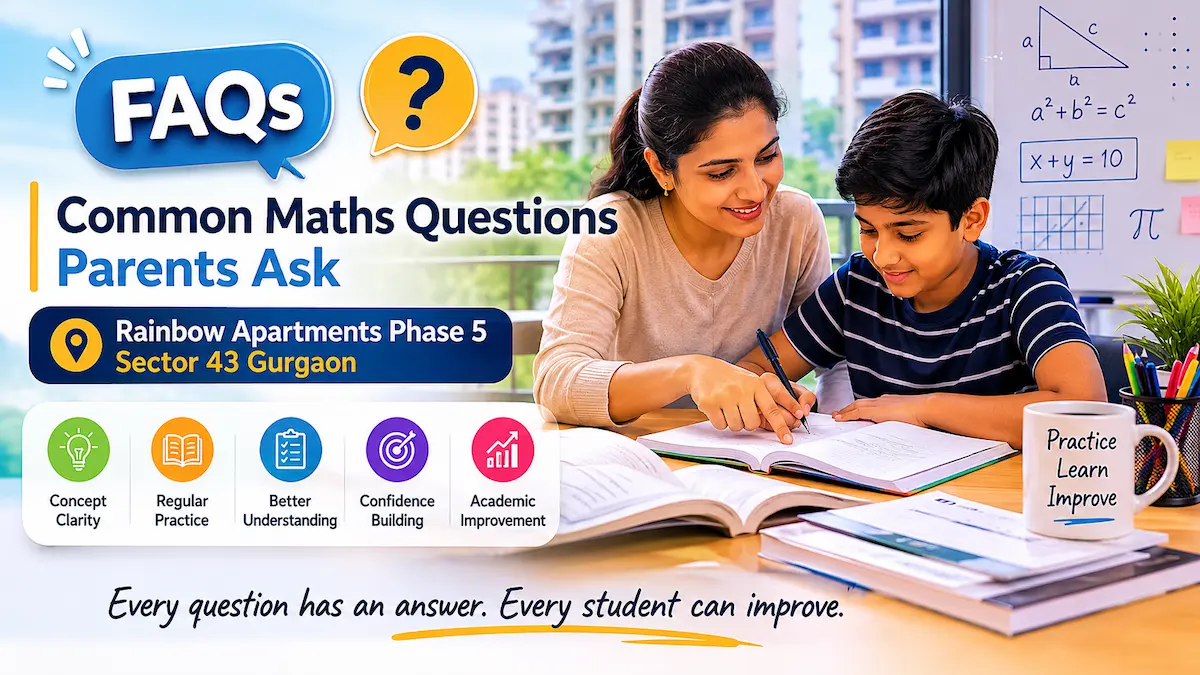
Common Maths Questions Parents Ask in Rainbow Apartments Phase 5 Gurgaon
Many parents in Rainbow Apartments Phase 5, Sector 43 Gurgaon, want to understand how they can help their children perform better in Mathematics. While some students struggle with confidence, others face difficulties with problem-solving, accuracy, or exam preparation despite attending school regularly.
The good news is that most Maths difficulties can be improved through consistent practice, better study habits, and timely academic support.
This article answers some of the most common questions parents ask about Maths learning and academic improvement.
Why Do Many Students Struggle in Maths?
Students often face challenges in Maths for different reasons:
- Weak understanding of earlier concepts
- Lack of regular practice
- Difficulty applying concepts in new situations
- Fear of making mistakes
- Poor exam presentation skills
- Low confidence after a few poor test results
In many cases, the issue is not ability but gaps in understanding that gradually become larger over time.
For a deeper understanding, parents can also read our article on Why Students Struggle in Maths and How to Fix It Early.
How Much Maths Practice Is Usually Helpful?
Regular practice is generally more effective than occasional long study sessions.
Students often benefit from:
- Short daily practice sessions
- Weekly revision of previously learned topics
- Solving mixed question sets
- Reviewing mistakes from earlier tests
Consistency usually produces better results than studying only before examinations.
Why Do Students Lose Confidence in Maths?
Confidence often decreases when students:
- Repeatedly make similar mistakes
- Score lower than expected in tests
- Compare themselves with classmates
- Avoid difficult topics
The longer these issues continue, the harder students find it to participate confidently in class or attempt challenging questions.
Confidence usually improves when students experience small but consistent academic progress.
What Are Some Common Maths Mistakes Students Make?
Some frequently observed mistakes include:
- Careless calculation errors
- Misreading questions
- Missing important steps
- Poor time management
- Incomplete solutions
- Incorrect presentation of working
Many of these mistakes can be reduced through structured practice and regular review.
Parents may also find our article Common Maths Mistakes Students Make in Exams useful.
How Can Parents Support Maths Learning at Home?
Parents do not need to be Maths experts to support learning.
Helpful approaches include:
- Encouraging regular study habits
- Maintaining realistic expectations
- Focusing on improvement rather than perfection
- Creating a distraction-free study environment
- Celebrating small academic progress
A positive learning environment often helps students remain motivated.
Is Online Maths Learning Effective?
Online learning can be effective when students receive:
- Clear explanations
- Regular practice work
- Opportunities to ask questions
- Consistent feedback
Many students appreciate the flexibility and convenience of structured online learning.
When Should Parents Consider Additional Academic Support?
Parents may consider additional support when a student:
- Continues struggling despite regular effort
- Frequently loses confidence in Maths
- Shows significant gaps in understanding
- Finds it difficult to complete school assignments independently
- Experiences repeated difficulties in tests and examinations
Early intervention often helps prevent small learning gaps from becoming larger academic challenges.
How Long Does It Take to Improve in Maths?
Improvement varies from student to student.
However, many students begin noticing positive changes when they:
- Practice consistently
- Review mistakes carefully
- Strengthen weak concepts
- Follow a structured learning routine
Academic improvement is usually gradual rather than immediate.
Do Students in Rainbow Apartments Phase 5 Face Similar Maths Challenges?
Many parents living in Rainbow Apartments Phase 5 and nearby
residential communities in Sector 43 Gurgaon notice similar concerns. Students
may lose confidence after poor test results, struggle with consistency, or find
certain topics difficult despite regular school attendance. In most cases,
these challenges can be improved through better study habits, regular practice,
and timely academic support.
Frequently Asked Questions
Is it normal for students to find Maths difficult?
Yes. Many students experience difficulties at different stages of their academic journey. Most challenges can be improved through consistent effort and structured learning.
Can confidence in Maths be improved?
Yes. Confidence often increases when students develop stronger fundamentals and experience regular success through practice.
Should students study Maths every day?
Short daily practice sessions are often more effective than infrequent long study sessions.
Do mistakes in Maths mean a student is weak?
Not necessarily. Mistakes frequently help identify areas that need additional practice and clarification.
Is It Normal for Students to Lose Confidence After a Few Poor Maths Marks?
Yes. Confidence often drops when students begin comparing themselves with classmates or focus only on marks instead of progress. In many cases, confidence improves when students understand their mistakes, strengthen weak topics, and experience small academic improvements through regular practice.
Further Reading
Parents interested in helping students strengthen Maths understanding may find these resources useful:
- Why Students Struggle in Maths and How to Fix It Early
- How to Study Maths Effectively
- Common Maths Mistakes Students Make in Exams
- How to Improve Accuracy and Score Higher in Maths Exams
For broader academic guidance, parents can also explore our dedicated Maths Tuition in Gurgaon page for a broader overview of home and online Maths learning support across Gurgaon.
These resources may help parents better understand common Maths learning challenges and practical ways to support consistent academic improvement.