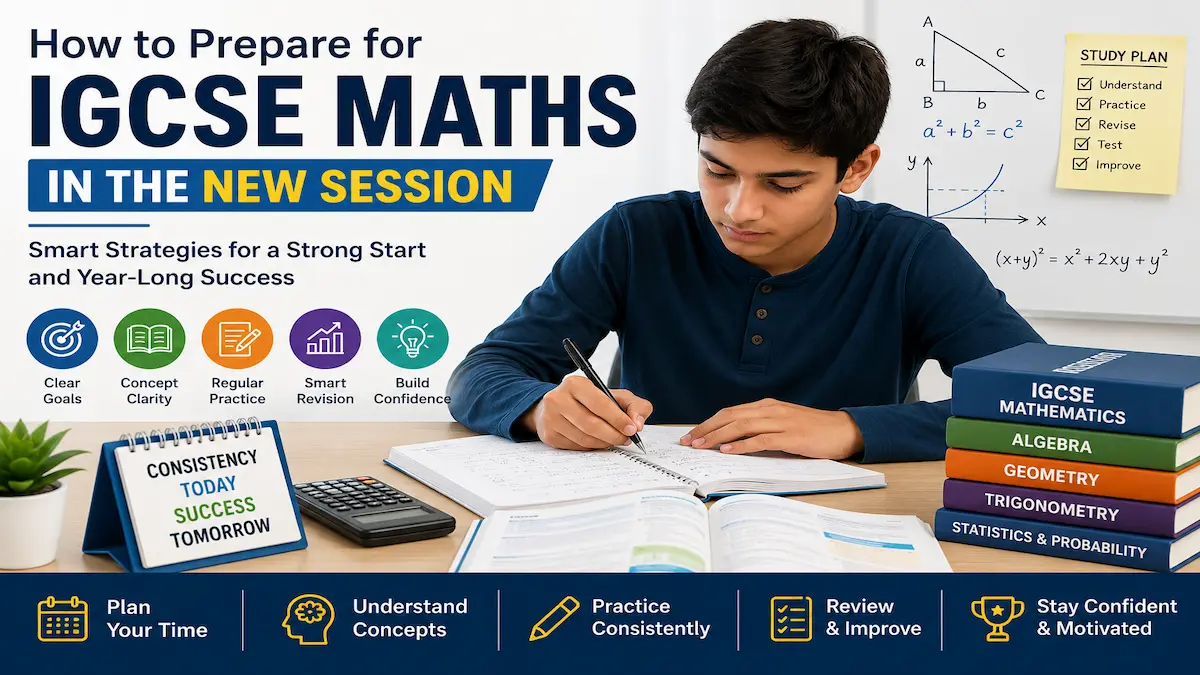
How to Prepare for IGCSE Maths in the New Session
The beginning of a new IGCSE academic session is one of the best opportunities for students to build strong mathematical foundations. Unlike preparing only a few months before examinations, students who develop good study habits from the start usually find later topics easier to understand and less stressful.
Many parents notice that the first few weeks of the IGCSE programme introduce a different style of learning. Students are expected not only to remember formulas but also to interpret questions carefully, explain their reasoning, and apply concepts to unfamiliar situations.
Students who establish good study habits during the first few months of the IGCSE academic session usually find later topics easier to manage because every new chapter builds upon earlier concepts.
In this guide, we discuss practical ways students can prepare for IGCSE Maths from the beginning of the academic year.
Why the Beginning of the Session Matters
Many students believe they can study seriously closer to the examinations.
Unfortunately, IGCSE Mathematics is cumulative.
Topics learned during the first term often become the foundation for later chapters.
Students who postpone revision often experience:
- Difficulty understanding advanced topics
- Lower confidence during class
- Frequent calculation mistakes
- Slow problem-solving speed
- Stress before assessments
A strong beginning usually makes the rest of the academic year more manageable.
A Simple IGCSE Maths Study Plan for the First Three Months
Month 1
- Understand classroom concepts
- Organise notes
- Solve textbook questions
Month 2
- Revise previous topics weekly
- Begin mixed questions
Month 3
- Start timed practice
- Analyse mistakes
Understand the IGCSE Learning Style
One of the biggest adjustments for students is understanding that IGCSE focuses on application rather than memorisation.
Students are expected to:
- Explain mathematical reasoning
- Solve unfamiliar questions
- Apply concepts in different situations
- Interpret diagrams carefully
- Present clear mathematical working
Developing these skills gradually throughout the year is much easier than trying to learn them just before examinations.
Parents looking for a broader understanding of curriculum-specific academic support can also explore our IGCSE Maths Tuition in Gurgaon page.
Build Strong Foundations Before Moving Ahead
Many difficulties in Grade 10 begin because students have small gaps in earlier concepts.
Parents should encourage students to strengthen topics such as:
- Algebra
- Linear Equations
- Graphs
- Coordinate Geometry
- Fractions
- Percentages
- Basic Trigonometry
Strong fundamentals make higher-level topics significantly easier.
Create a Weekly Study Routine
Students do not need extremely long study sessions.
A simple weekly routine often produces better results.
For example:
- Review classroom notes
- Solve textbook questions
- Revise one previous topic
- Attempt a few mixed problems
- Correct mistakes carefully
Consistency is usually more important than intensity.
Developing a regular study routine becomes easier when students follow structured learning habits. You may also like our guide How to Study Maths Effectively: A Complete Guide for Students & Parents.
Practise Different Types of Questions
Many students become comfortable solving only familiar exercises.
IGCSE examinations often include application-based questions.
Students should regularly practise:
- Direct questions
- Word problems
- Multi-step questions
- Graph interpretation
- Mixed-topic questions
Exposure to different question styles improves confidence and flexibility.
Learn From Mistakes Instead of Ignoring Them
One habit that separates stronger students is reviewing mistakes.
Instead of simply checking the correct answer, students should ask:
- Why was the mistake made?
- Was it a concept error?
- Was it a calculation mistake?
- Was the question misunderstood?
Keeping a small notebook of repeated mistakes can help prevent similar errors later.
Students who frequently lose marks because of avoidable errors may also find our article Common Maths Mistakes Students Make in Exams helpful.
Improve Mathematical Presentation
Marks are often lost because of poor presentation rather than incorrect understanding.
Students should practise:
- Showing complete working
- Labelling graphs correctly
- Writing mathematical steps clearly
- Checking calculations
- Reading questions twice
Clear presentation also helps students identify their own mistakes.
Build Confidence Through Regular Revision
Confidence in Mathematics usually develops through repeated success.
Instead of waiting for examinations:
- Revise every week
- Solve previous mistakes
- Practise mixed questions
- Ask doubts promptly
Small improvements over several months often produce significant long-term progress.
How Parents Can Support Students During the New Session
Parents do not need to teach Mathematics themselves.
Instead, they can help by:
- Encouraging a consistent study routine
- Monitoring revision habits
- Celebrating small improvements
- Avoiding unnecessary comparison with classmates
- Supporting confidence after mistakes
A positive learning environment often improves motivation more than pressure.
Common Mistakes Students Make During the New Session
Many students lose valuable time because they:
- Delay regular revision
- Ignore weak concepts
- Practise only before tests
- Memorise instead of understanding
- Avoid asking questions
Identifying these habits early can prevent larger academic difficulties later.
Frequently Asked Questions
How much should an IGCSE student study Maths every week?
Regular practice throughout the week is usually more effective than long study sessions only before tests.
Is it necessary to finish every chapter immediately?
No. Understanding concepts thoroughly is more important than rushing through the syllabus.
Should students solve previous papers at the beginning of the session?
Previous papers become more useful after students have covered a reasonable portion of the syllabus. Early in the session, students should focus mainly on building concepts and practising topic-wise questions.
Can weak students improve in IGCSE Maths?
Yes. Many students improve significantly through regular practice, concept clarification, and consistent revision from the beginning of the academic year.
Final Thoughts
The new IGCSE academic session offers students an excellent opportunity to build strong learning habits before the syllabus becomes more demanding. Students who focus on understanding concepts, practising consistently, reviewing mistakes, and building confidence from the beginning of the year usually find it easier to handle more challenging topics later.
Rather than studying for long hours only before school assessments, steady weekly progress leads to stronger mathematical thinking and long-term academic improvement. Small, consistent efforts often produce better results than last-minute preparation.
Parents also play an important role by encouraging realistic study routines, supporting independent learning, and helping students view mistakes as opportunities to improve rather than setbacks. A positive learning environment often makes the entire IGCSE journey more enjoyable and less stressful.
If your child often finds Maths challenging or loses confidence after making mistakes, you may also find our article Why Students Struggle in Maths and How to Fix It Early helpful. It explains the most common reasons students face difficulties in Maths and practical ways to overcome them through consistent learning habits.