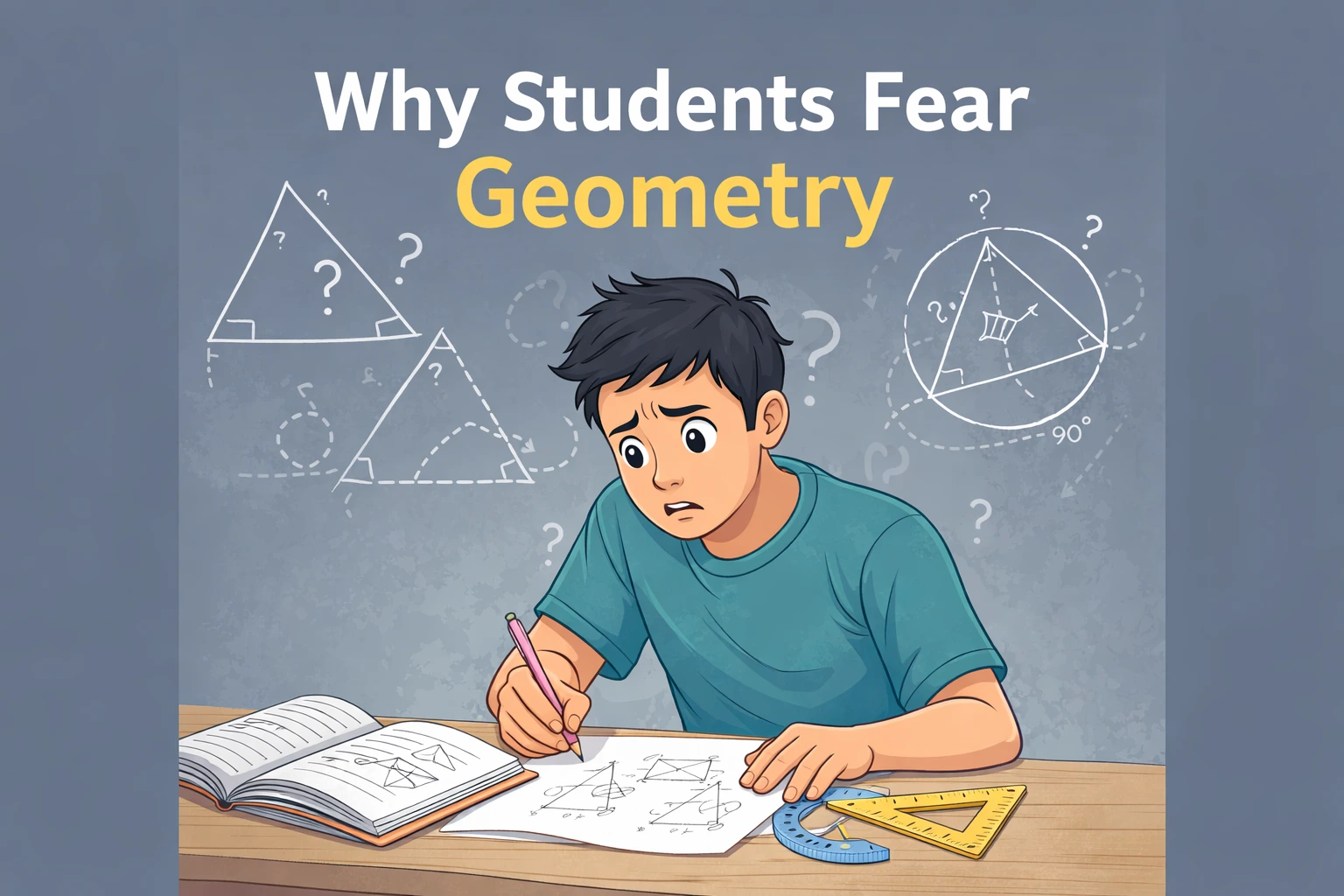
Why Students Fear Geometry (And How the Right Approach Can Fix It)
Geometry is one of the most common fear points in mathematics. Many students who are comfortable with arithmetic or algebra suddenly lose confidence when geometry is introduced. This fear develops gradually due to weak foundations, lack of visual understanding, and exam pressure.
Understanding why students fear geometry is the first step toward helping them improve confidence and performance.
Geometry Is Visual, But Often Taught as Theory
Geometry is a visual subject, but it is often taught only through formulas and written steps. When students cannot clearly visualise diagrams, angles, or constructions, geometry becomes something to memorise rather than understand.
This creates confusion and hesitation, especially during exams when students must solve diagram-based questions independently.
Weak Foundations from Earlier Classes
Geometry concepts are strongly
interconnected. If students are not confident with:
- basic angle properties
- triangles
- quadrilaterals
they struggle when advanced
topics such as circles and coordinate geometry are introduced.
This is why geometry fear often begins in Class 9, when the syllabus suddenly becomes more concept-heavy. A clearer understanding of learning expectations at each stage is explained in our Class-Wise Maths Support section.
Many parents notice this struggle starting in Class 9, when geometry becomes more rigorous. You can read more about how personalised support helps at this stage in our Class 9 Math Home Tutor guide.
Fear of Proofs and Logical Reasoning
Many students believe geometry proofs are about memorising steps. In reality, proofs require clear logical thinking. When logic is not explained step by step, students feel lost and begin to avoid geometry questions altogether.
This fear often intensifies as students move closer to board exam classes.
Geometry Pressure Increases in Board Exam Classes
In higher classes, geometry questions require:
accurate diagrams
multi-step reasoning
proper presentation
During board exam preparation, even small mistakes can cost marks. This is why Class 10 students often feel maximum pressure in geometry, despite understanding the basics.
In Class 10, geometry becomes a high-scoring yet high-pressure area. Many parents look for focused guidance during this stage, which is explained in detail in our Math Tutors for Class 10 resource.
Many of these exam-related challenges can be reduced with the right preparation approach, which is discussed in our Exam Preparation & Revision section.
How the Right Learning Approach Fixes Geometry Fear
Concept Clarity Before Formulas
Students must first understand why a theorem works. Once logic is clear, formulas are easier to remember and apply.
Diagram-Based Explanation
Visual learning helps students connect concepts instead of memorising steps blindly.
Step-by-Step Logical Thinking
Breaking answers into small logical steps builds confidence and reduces exam anxiety.
Consistent Guided Practice
Regular practice under proper guidance helps students approach geometry calmly and confidently.
These methods are part of effective study habits that help students learn maths with clarity and confidence, as explained in our Math Learning Tips section.
Geometry fear reduces significantly when students receive structured guidance and individual attention. You can explore our Maths Tuition programs designed to strengthen fundamentals and build long-term confidence.
Geometry Can Become a Scoring Subject
With the right approach, geometry can transform from a fear into a strength. Many students who once avoided geometry begin to score consistently once concepts are explained clearly and practiced regularly.
Confidence in geometry often improves overall performance in mathematics.
Frequently Asked Questions
Why do students find geometry harder than algebra?
Geometry requires visual understanding and logical reasoning, while algebra focuses more on numerical manipulation.
At which class does geometry become difficult?
Most students begin to struggle from Class 8 or Class 9, when abstract reasoning and proofs are introduced.
Can geometry be improved with practice?
Yes. With concept clarity, diagram-based learning, and guided practice, geometry performance improves significantly.